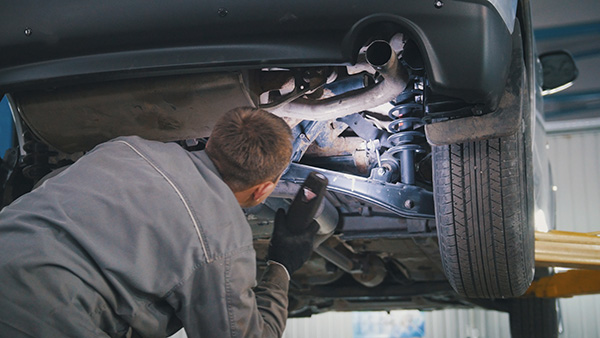
Some roads make every car feel a little busy. But if your vehicle feels nervous, floaty, or unpredictable anytime the pavement gets rough, that’s different. You might notice it on patched asphalt, bridge joints, or those wavy sections of freeway that make the car drift even when you are holding the steering wheel steady.
An unstable feel on uneven roads usually comes from a grip-and-control issue. Tires, alignment, and suspension all play a role. The good news is that this problem almost always leaves clues you can follow.
Why Uneven Pavement Exposes Weak Points
On a smooth road, your tires stay consistently loaded, and the suspension only has to manage small movements. Uneven surfaces constantly change the load on each tire. The suspension has to react quickly, and the steering system has to keep the wheels tracking straight while the tires hit bumps at slightly different times.
If a component is worn, the car can lose composure. The tires may not stay planted. Alignment angles may shift under load. The steering may require constant corrections. That is why a vehicle that feels fine on a fresh road can feel unsettled on older pavement.
Tires: The First Thing That Touches the Problem
Tires are often the biggest contributor to instability on rough roads. If the tread is uneven, the tire can follow grooves and seams more aggressively. That can feel like the car wants to steer itself.
Low tire pressure can cause the tire sidewall to flex too much, resulting in a delayed response. Overinflation can reduce compliance and make the car bounce off imperfections instead of absorbing them. Tire construction matters too. Some tires have stiffer sidewalls that sharpen response but can feel more nervous on broken pavement.
If the instability appears right after new tires, it is worth checking the pressure and confirming the tires are a good match for the vehicle. We’ve seen cases where a tire choice improved steering response on smooth roads, but the same tire made the car more sensitive on rough roads.
Alignment And Road Crown Effects
Alignment affects how the vehicle tracks and how the tires meet the road. Toe, camber, and caster settings influence stability. If the toe is off, the car can feel twitchy and require corrections. If the camber or caster is uneven side to side, the car can pull or drift.
Uneven roads add another layer, because road crowns and grooves can amplify small alignment issues. A vehicle with marginal alignment might feel acceptable on flat pavement but feel unstable on wavy roads where the tires are constantly being deflected.
If the steering wheel is off-center or the vehicle pulls on a flat road, that is a strong sign alignment needs attention. If alignment was done recently but the car still feels unstable, worn parts that allow alignment angles to shift under load become more likely.
Shocks, Struts, And Damping Control
Shocks and struts control motion. They do not hold the car up, but they control how the suspension moves after a bump. When they get weak, the car can bounce longer than it should, and the tires can lose consistent contact with the road over rough surfaces.
A vehicle with weak damping often feels unsettled on bumpy highways. It may take longer to calm down after a dip. It can also feel like the front or rear end is constantly reacting instead of staying composed.
This is one reason a driver may describe the car as unstable even though nothing is visibly broken. Damping loss can be gradual, and people adapt until they drive a newer vehicle and realize how different it should feel.
Bushings And Joints That Let the Wheels Shift
Suspension bushings and steering joints are designed to allow controlled movement, not free movement. Over time, rubber bushings can crack and soften. Ball joints and tie rod ends can develop play. When that happens, the wheel can shift slightly under load.
On uneven roads, shifting wheels create a drifting or wandering feeling. The car may feel like it changes direction slightly as each wheel hits a bump. That sensation often gets worse at highway speed or during braking on rough pavement.
If you also hear clunks over bumps, or you notice uneven tire wear patterns, worn bushings, or joints, they become more likely. In our shop, we often find that instability complaints on rough roads trace back to worn bushings that allow alignment changes under load.
A Simple Guide To When It’s Time To Inspect
If the vehicle occasionally feels a little busy on bad pavement, that can be normal. If it feels unpredictable or tiring to drive, that’s when inspection is worth it.
Schedule a check if you notice any of these:
- The car wanders on rough highways and needs constant steering correction
- You feel repeated bouncing after dips or speed bumps
- Tire wear is uneven or keeps returning after alignments
- You hear clunks over bumps or during low-speed turns
- The steering wheel does not return to center consistently
If traction or stability warnings appear on the dashboard along with an unstable feel, treat it as a sign that the vehicle is not tracking the way the system expects.
Get Steering And Suspension Service in San Jose, CA, with Dhillon Motorsports
We can inspect your tires, alignment angles, and suspension components to find out why the vehicle feels unstable on uneven roads. We’ll check shocks and struts, bushings, joints, and wheel-end components, then recommend the repairs that restore steady handling.
Call Dhillon Motorsports in San Jose, CA, to schedule an inspection and get your vehicle feeling predictable again.